Showing posts with label English. Show all posts

Monday, August 8, 2022

Practical Ways to Teach Writing Research Papers - And How to NOT Make it a Boring Chore

   This is a little video I made of a slideshow from one of my sessions at Faith Builder's  Teachers Week.  If you would like more information on gently guiding students through the process of writing research papers, a recommended resource is below.  


Forty-five pages of information, examples, and specific details

$15 plus shipping 

Click HERE or use the "Contact Us" form above if you are interested.

Tuesday, May 31, 2022

Five Helpful Practices for English Class

This was originally written for and published at The Dock for Learning.  


 Five Helpful Practices for English Class


Here are a few suggestions that I have found to be very helpful when teaching English classes.  Too often, some of these concepts are confusing to students, and they fail to grasp onto them, causing them to dislike the subject.  I have found that consistently repeating these five practices greatly increased my students’ understanding and enjoyment of the class.  


1. Always give the same example when learning a concept so that it will stick in the students’ minds better.  

Examples –  Direct objects:  The hen laid an egg. 

Indirect objects:  David Brainerd gave the Indians Bibles. (He wasn't giving away Indians.)

Appositives:  Fred, my student, got an A on the test.

Appositive adjectives: Fred, diligent and hard-working, makes good grades.


2.  When working on diagramming sentences, after using some of the examples in the text book,  diagram a few sentences about your students and things that happened at school.  They usually love this. 


3.  Make writing enjoyable.  If students write a few sentences a day and enjoy it, the harder and more difficult assignments suddenly become much less of a chore.  Using journals daily is a great practice for this.  (See Journal Writing 101 for ideas and resources.)


4.  Tackle larger assignments like research papers in smaller chunks.  Make each step due fairly soon, give a grade on each step,  and keep your students accountable.  Dragging it out for weeks feeds procrastination, apathy, and is a breeding ground for students hating writing.  It is much more palatable for them to tackle it and write while they have the thoughts and ideas in their brains.  In a week, they will have forgotten much of it.  I often will make something due every day for two weeks during research paper season, and we will often spend twenty minutes of class doing it.  I give them good examples (often from former students’ writing) and cheer them on.  They work and write and turn in some good stuff. 


5.  Read quality literature (including poetry) aloud each day.  They need to hear it, and the more they get used to it, the more they will appreciate it.  Use voice inflections and be a little dramatic when the piece calls for it –  (“The Raven,” anyone?)  I once had a class which was really struggling with literature.  I got another student to read one of the plays in the literature book aloud with me.  We were all laughing so hard (it was a comedy) that I had tears running down my cheeks.  They began to enjoy literature much more after that.  


Friday, November 27, 2020

Business Letters Reap Rewards

                      Recently the ninth grade curriculum we use covered writing business letters.  The assignment was for the students to write a fake business letter and hand it in.  Instead, we wrote real business letters to the departments of tourism for twenty-six different states.  After I proofed them all, each student addressed his or her envelope, added the return address (the school's), put stamps in the right place, and marched single-file to the mailbox so that each student could mail his own letter.  For the past few weeks, we've received packages with magazines, maps, pencils, pins, bookmarks, and nice business letters in return, too!  It has been a great way for the students to learn about writing business letters.  (Note:  We used only initials and no student's full name.)  


Monday, October 26, 2020

The One That Got Away

It is not only bow hunting season, but it is also personal experience speech season.  One of the seniors in my speech class showed up for his speech wearing camouflage (extra points!) and related his experience of missing a buck -- three times.  We all enjoyed his true story, and he enjoyed his A+.  

Sunday, May 12, 2019

Grading Research Papers -- Really?


I take my job as English teacher of the seventh and eighth grades pretty seriously.  To me, that means that I do the following when it comes time for research papers.

1.  I present a slideshow of topics which includes about sixty American history topics and sixty world history topics.  I also often say, "This would be a great research paper topic," when we cover something amazing in history, and then I add it to the list.  Usually,  my students pick a topic that they are truly interested in.  (I have a slideshow of topics with pictures that I share if you are interested in seeing it.  Email me at litleflock7 at gmail.com and I'll be happy to share it with you.)

2.  I take the students on a field trip, or I go to the library myself and find lots of good books on their topics.  (I also order books for the ones whose topics are a little out of the ordinary.) 

3.  I check every single note card and source as the students are working on gathering information for their reports.  

4.  I spend hours grading their research papers.  I mark every run-on sentence, fragment, and misspelled word.  I also write "awk" wherever their writing is awkward, and I draw a squiggly line under any word that I would call a "first grade word."  They know that squiggly line means to get a Thesaurus and find a bigger, better word. 

5.  I really do get a ruler and measure all the margins on their second (typed) drafts.  I also check all the spacing, parenthetical citations, page numbers, capitals, and the italics in the thesis statement on their outlines.  

6.  I also give them ample time and opportunities to correct all their mistakes, so that the final product is really a work of art.  Even though it is a lot of hard work, they know they've accomplished something grand.  

Getting middle school students ready for high school is an important job, and we should take it seriously.  

Saturday, March 30, 2019

Peer Editing Research Papers


Now that the seventh and eighth graders had their research paper rough drafts completed, it was time to work on corrections for their second rough drafts.  Each student made his own corrections, and then we spent some time in class working on peer editing.  They read their papers out loud to another student, and that student made suggestions or corrections.  It is a great way for them to hear what their writing sounds like, and it is a great way for them to give each other feedback.  


Monday, January 28, 2019

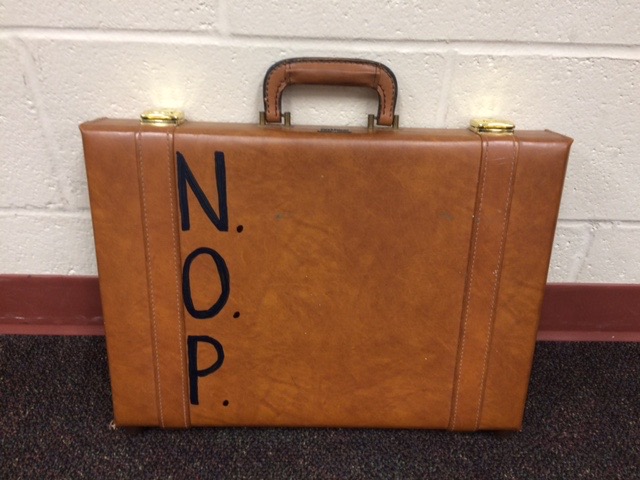
Mr. NOP Teaches Pronouns


I have found that often students draw a blank when the words "nominative case, objective case, or possessive case pronouns" are used.  "What?" they often seem to say, think, or express on their faces.  It is SO HELPFUL if we teachers give our students a way to remember what all those gobbledygook words mean, and the way I do this is to use the word case as the "trigger word."  This, hopefully, will help them to remember the briefcase I use.  The briefcase belongs to a man whose initials are N.O.P., which stands for nominative, objective, and possessive, of course.  

I also use the words themselves to help students remember when to use them.
Nominative case is used for subjects and predicate nominatives.  (And I lean forward and stress the word nominatives.)

Objective case is used for -- surprise -- direct objects, indirect objects, and objects of the preposition.  (More leaning forward and stressing the word objects here.) 

And, possessive case is used when someone possesses something.  At this point of the lesson I grab the briefcase or my coffee cup and loudly say, "I POSSESS this!  It is MINE, MINE, MINE!"  Then I have them grab something on their desks and say, "I POSSESS this!  It is mine!"  Yes, they really do it, and they giggle a bit too, and they usually remember it.

It is also helpful to use sentences to help them double-check to see if they have used the correct case. 

For nominative case pronouns, the sentence is "_____ went to the store."
Then we all point to each other and say that sentence with all of the nominative case pronouns in order like this.
"I went to the store.  You went to the store.  He went to the store.  She went to the store.  It went to the store.  We went to the store.  They went to the store."   

The same process is used for objective case pronouns, but the object is a gift, and the sentence for this one is "The gift is for me.  The gift is for you, . . . etc."  

For possessive case pronouns, the same chant is used, only we do it twice for each one; first as an adjective and secondly as a pronoun.
"It's my cup; the cup is mine.  It's your cup; the cup is yours . . . . " 

It is helpful to remember that if the possessive pronoun is functioning as an adjective, there is always a noun behind it.  
   And,  if it is functioning as a pronoun, the PRONOUN stands ALONE (said with emphasis on the long "o" sounds.)  

Thursday, December 13, 2018

The Tardy Boys

We had so much fun finding all those participles in the Hardy Boys books that I thought we should write some of our own.  So, for a journal assignment, I had the students write three book titles which contained a participle.  Only instead of it being The Hardy Boys, they would be writing titles about events that had really happened at school, and so we would call it The Tardy Boys.  Here are some of my favorites.  

One girl's lunch stank up the entire downstairs of the school . 

 
The eighth graders are notorious for leaving dirty tissues scattered everywhere -- and the other grades let them know about it.  

I assure you, it's happy screaming about something exciting -- like a 95.55 class average on a hard four-page grammar test today.


Gym class.  No explanation needed.

I'm not sure if this would be a sequel to The Stinking Shoe or not, but sometimes a lot of Axe gets sprayed after a physical education class.  


One day during class, a large piece of fabric fell down onto a few of the students.  


We couldn't get a good picture of the real class bells, but they are frequently off schedule.  


Another pet peeve of mine is bouncing basketballs right outside my door while I'm teaching.  The rule is that if anyone gets caught bouncing a ball there, I confiscate the ball and the student owes me chocolate to get it back.  

Sequel.  

The most dangerous seats in my room are the ones by my messy closet -- especially after an achievement party when I've been digging in there.  

Read about this true school happening here.  

One of the turtles in Mr. Caleb's science room escaped and was recovered.

Saturday, November 24, 2018

The Hardy Boys Love Participles! (Really)

Okay all you English teachers, I have stumbled upon a great way to teach participles- especially to guys who have a hard time grasping concepts other than "play ball" and "fix engine."
  
Many of the Hardy Boys book titles have participles in them!  I was working with my son on participles for the umpteenth time, and as three of us at our house are reading a Hardy Boys book right now (including me -- it's worth it to bond with my sons and talk about what funny things Chet does), I looked at a few of the titles and - there they were.  Participles!  
  
So I grabbed my camera, went over to our three shelves of Hardy Boys books, and began taking pictures of all eighteen of them.  I made this into a slide show to use just to teach participles, so if any of you are interested, I'm more than willing to share.  (Just email me at littleflock7 at gmail.com.)   Now I've got to do something better with my time these precious few days off . . . . 
To see my students' creative Tardy Boys titles with participles, click here

Bonus points here -- DOUBLE PARTICIPLES ! ! That's like spelling a word with a "Z" in it on a triple word score square in Scrabble.


Check out that movie camera!