Showing posts with label Science. Show all posts

Thursday, December 29, 2022

Do Every Science Experiment in the Book


Because I try to have my students do as much hands-on learning as I possibly can while still covering all the material in the textbooks, one of my educational policies is to try to do every science experiment in the book.  Having this policy has been great for me and for my students.  They know that I've said that, and so they keep me accountable, and they expect us to do them.  It's amazing how much more we learn, and how much better we understand the material when we actually do and see what happens rather than just read about it.  

Our last experiment was to put chicken bones in vinegar.  After only about five days, we could tie the chicken bones into knots; they were just like rubber, just like the book said they would be.  It was way more fun to tie them in knots ourselves than to just look at the pictures of it in the book, even if it did make our hands a little stinky.  


Wednesday, November 9, 2022

"Make Like a Leaf and Fall" Art


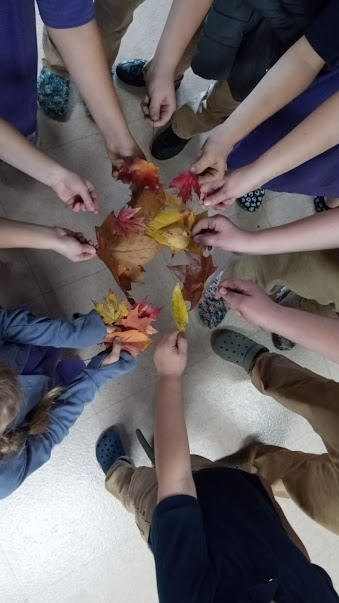
     This art and science project began with our "Wednesday walk."  Following some advice from Charlotte Mason, every Wednesday we take a nature walk, observe, explore, and investigate anything we see or hear out in nature.  Our assignment this day was to collect a few leaves which had two or three different colors.  We sketched and then painted leaves with watercolors to match our real leaves as closely as we could.  


Friday, September 2, 2022

Flora and Fauna -- Well, Troglofauna


     We ate lunch and then had our science class on the bridge one day this week.  We were studying flora and fauna in our junior high science books.  Since the tennis balls I had ordered hadn't arrived in the mail yet, we decided to take another nature walk on our way to the playground.  We tried to find as many kinds of flora and fauna as we could, and we found a lot.  Technically, zipper spiders are a  troglofaunal species, so that counts, too.  


And we did make it to the playground.  

Saturday, July 23, 2022

Top Five Practices for Science Class

 This post was originally written for and posted (without the photos) on The Dock for Learning.

Top Five Practices for Science Class 


When I think back to when I was in school, I think science was my least favorite subject.  It didn’t make sense to me, and I thought it was boring.  Now that I’m teaching, science is one of my favorite subjects.  Doing these five steps made the difference.  


  1.  Do every experiment in the book.  You’ve got to plan a little ahead to do this, but it is so worth it.  Before school starts, get a bin and collect everything that you will need to do the experiments, or at least look a day or so ahead and get the supplies that will be needed.  Students learn about four times as much when they see actual things being done rather than just reading it in the book, although we should always read it in the book, too.


  1.  Keep science sketchbooks.  Give each student a blank sketchbook with no lines.  As you are going over the lesson, encourage students to draw (use colored pencils) and label the main points of what you are studying that day.  While my students do write the vocabulary terms and short definitions for them in these books, most of the content in the sketch books consists of drawings with color and arrows to show movement.  I always tell my students what to draw and model it for them up on the board or in my sketchbook.  That way they can see exactly what I expect them to write and draw, and this avoids many questions.  


  1.  Learn outside of the books.  Grow plants in the classroom.  Place a bird feeder near a classroom window and identify birds.  Encourage and even reward students for finding fossils, bones, unusual leaves or anything from God’s creation.  Have them bring these into the classroom for everyone to see. 


  1.  Find as many tangible examples of what you are studying in the book as you can.  These can be found inexpensively at garage sales, thrift stores, online, or for free if your students find them and bring them in.  To look at pictures in the book is nice, but your students will learn much more if they identify the types of clouds at recess; or hold a piece of granite, a cow femur, or a fossil in their hands. 


  1.  Go on nature walks during recess.  While we will often find examples of what we have been studying in science on our nature walks such as windmills, rock samples, plants, insects, mammals, etc., sometimes we will not, but we will always look for and find some type of interesting science item and enjoy the fresh air and exercise while we do.  


Tuesday, July 19, 2022

Using Science Sketchbooks in the Classroom Tutorial


In the middle of the last school year, I was looking for something to get my students more engaged in science.  We were doing every experiment in the book plus some extras I found, but I wanted my students to interact with the material in the textbooks more.  After some research, I found the idea of using science sketchbooks. Here's how it worked for us. 

1.  Provide sketchbooks for students.  (This could also be just blank copier paper with holes punched in it in a 3 ring binder.). 

2.  After the science lesson, sketch the main concept on a piece of paper.  Model this by doing it yourself in your sketchbook for a smaller class, or on the board for a larger one.  Go slowly enough that they can follow you and draw exactly what you are drawing.  Narrarate it as you are drawing it so that the students can do it at the same time.  Example:  "Draw the fire in red.  Now draw the water in blue and make bubbles and steam going up to show that it's boiling.  Draw arrows to show the boiling water going to the piston . . . etc." 

3.  Use colored pencils and label parts.

4.  Write down any vocabulary words along with a brief definition.

5.  Use arrows to show motion! 

6.  Review all the sketches for whatever chapter or unit you are on at the beginning of every science lesson to aid retention. 

Not only was this quite enjoyable to do, but it really helped us understand the concepts better and retain the information longer.  Here is a video of what we did in class for the last several chapters in our science sketchbooks.  

Wednesday, May 11, 2022

Tuesday Tennis; Wednesday Walk


   It's easy for me to remember things if I use alliteration.  Thus, this year we've played tennis on many Tuesdays and taken walks on many Wednesdays.  We try to observe as many interesting science, art, or history types of things as we can on our walks, and we usually do find a few.  We found two dead fledging birds on the tennis court yesterday, and watched the last baby robin fly away from its nest on the front porch this morning. 

   Today we took a new route to walk around the perimeter of a tire company that has truckfulls of old tires sitting around.  We found all kinds of interesting sights like trees growing all around the trucks as they've been sitting there for so long, cats sleeping amongst the tires in the trucks, license plates from different states on the trucks, and an old bird's nest in a windowsill.  The nest had obviously been abandoned for quite some time, so we gently removed it and inspected the inside of it.  Alas, all of the birds had not made it to maturity as we found some bird bones inside the nest -- a backbone and a few wing and leg bones to be exact.  We're studying vertebrates in science, so this went along well with today's science lesson.  


Related Posts:


Wednesday, March 16, 2022

Outside Time


There is much research to show how much children benefit from being and playing outside, so we try to spend a chunk of time outside each day.  This usually takes two forms:  physical exercise and what I like to call "science time."  Sometimes we combine the two.  Last week we spent time walking and playing disc golf, among other activities.  

We found one of the first little spring flowers peeping up through the grass.  


While admiring this amazing tree (and trying to count the branches emerging from its trunk), we found a bird's nest hidden among the many branches.  


Out in one of our raised beds, we planted the veggies we had been growing in water.


We made more suet and enjoyed seeing a red-bellied woodpecker and a flicker at the feeders at the same time.  (In the picture below, you can actually see his red belly.) 


And we smelled a skunk, and then we found him.  This would be the spotted skunk variety, and not a striped skunk.  I learned about this the hard way.  

Wednesday, February 23, 2022

How to Make a Steam Engine


In science class, we are currently studying the chapter on engines, force, energy, etc.  I'm always looking for something new to do because I like to learn and experience the things we read about, and the students learn more that way, too.  We had studied steam engines, and I'd never made a steam engine.  So I researched it, and we did. 

Using JB WaterWeld, which I purchased online, we attached the top of a pen cap to the spout of a pop can.  Then, using a sharp knife, I, not the students, poked a hole in the side of the can and attached the bottom of the pen to the can for a filling spout. (I was supposed to use one with a screw-on removeable cap, but I didn't use one of those, so we just used tape.  Maybe next time.).  


We used hot glue and wire to prop up the can and a moveable fan made out of cardboard, a thin wooden dowel, and the center of a toilet paper tube.  Then we filled the can about 1/3 full using a funnel and the top spout.  We put four tea light candles underneath the can and waited.  


Although it did work and steam came out of the spout, it didn't have enough power to move the fan blades.  We decided that the cardboard was too heavy, so we disassembled the first wheel and made a second one out of lighter paper.  That one didn't spin either, but at least we had tried, and we did make a little steam engine that blew out steam.  


Related Posts:


Monday, January 24, 2022

Give Me Oil in My Lamp . . . and Help! Poisoned Peas!

Since we were learning about coal, petroleum, and other fossil fuels this day, I thought it would be interesting to make a simple oil lamp using vegetable oil, a piece of twine, and a tuna can.  It worked and burned for quite awhile.  

The birds love the suet we made.  They've already enjoyed all four cakes, so we made more this morning.
We wrote articles (about mostly true events), designed ads, printed, and coffee stained our colonial newspaper as we were getting ready for history night.  Here is a true story on the front page of our little newspaper about a man who attempted to poison George Washington's peas.  We learned about this from the book Phoebe the Spy, based on a true account.  


After reading about Benjamin Franklin's love of fourteen course meals, we researched them and decided to have one for our history night. We made apple tarts and cheese wafers using authentic colonial recipes.   I hadn't planned on having home economics classes this year, but I guess we did one anyway.